Reading Time – 4 minutes
Most of my business content focuses on how to start a brand-new, location-independent business and land your first one to three clients. That phase matters, because without it you never escape the nine-to-five. But today I want to talk about what happens after that stage—when you already have a few clients, some money coming in, and you realize something uncomfortable.
Your warm network is tapped out.
You’ve talked to your friends, former coworkers, acquaintances, and referrals. You’re busy delivering work, but you can feel the ceiling. If you don’t build a real sales process, you’ll either stay stuck at the same income level or slowly slide backward when clients finish their engagements and leave.
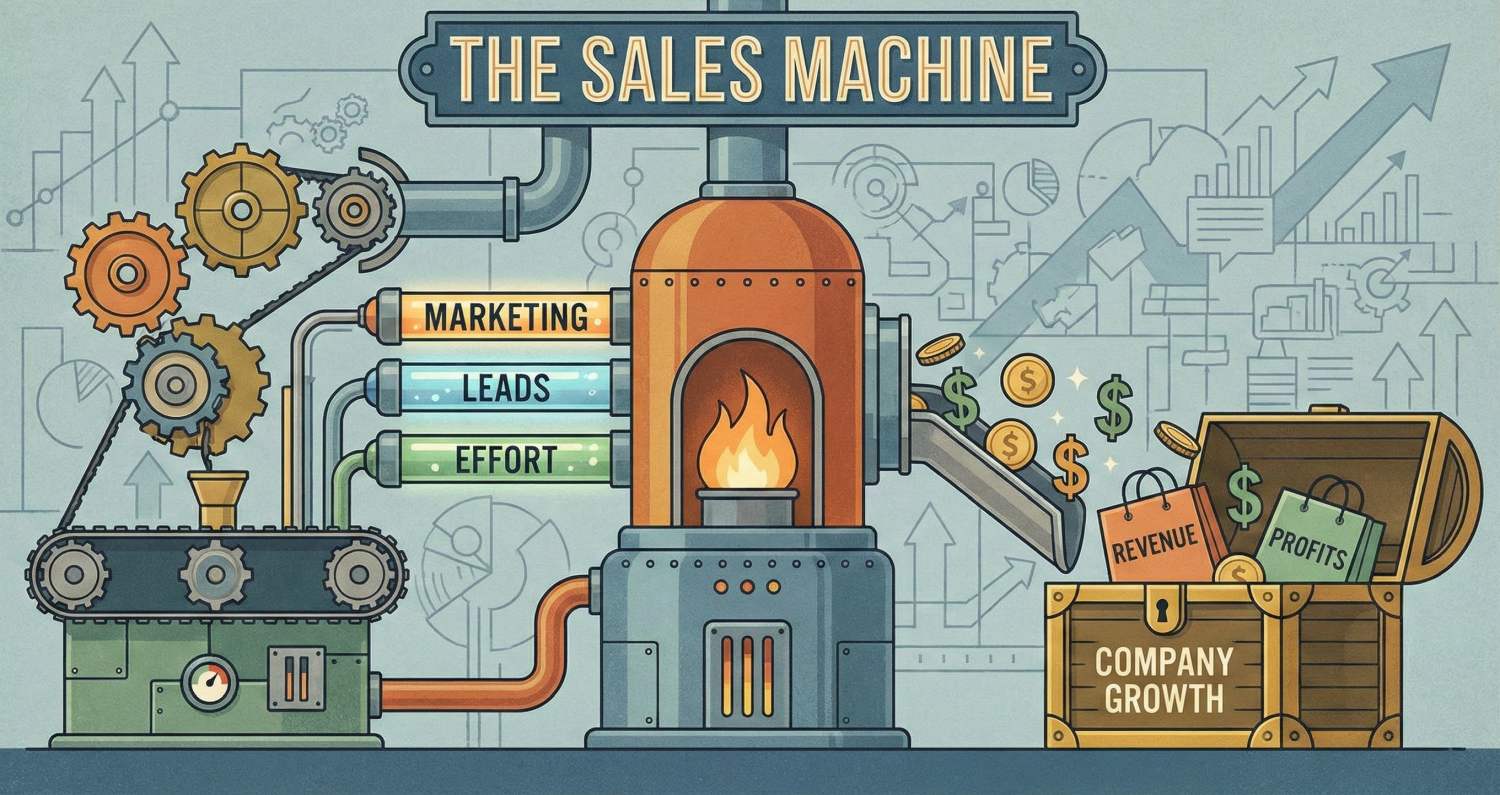
This is the point where you need to stop “finding clients” and start building a sales machine.
From Hustling to Systems
Early on, everything is manual. You’re doing outreach yourself, taking calls yourself, and closing deals yourself. That’s normal. But the goal is not to stay in that mode forever. The goal is to build a repeatable system that consistently brings you qualified leads and turns a percentage of them into paying clients.
That system usually starts with client acquisition, and there are several ways to do it.
You can run ads on platforms like Facebook, YouTube, or TikTok—wherever your niche already spends time. You can do cold outreach, such as direct messages or emails, using a structured script that identifies a specific problem and invites the prospect to take the next step. You can even combine multiple methods once you know what works.
What matters is not the channel. What matters is that you have something predictable bringing people into your world.
Every acquisition method needs a clear call to action. A call to action tells the prospect exactly what to do next.
If what you’re selling is relatively low-ticket—roughly under $2,000—you can often send people directly to a sales page where they can buy immediately.
But if you’re selling higher-ticket services, which I strongly recommend, the call to action should be to book a call. That call is where the real selling happens.
Between the initial outreach or ad and that call, you’ll usually have some kind of opt-in. This is where lead magnets come in.
Why Your Lead Magnet Has to Be Good
A lead magnet is not a throwaway PDF anymore. Those days are gone. If you want serious clients, your lead magnet needs to be genuinely valuable—something that feels like it could sell for $1,000 on its own.
That might be a short book, a detailed worksheet with exercises, a video series, an audio training, or a combination of all of these. The point is not to hide your best ideas. The point is to show prospects that you actually know what you’re doing.
You are not selling to people who want to solve their problems themselves. You’re selling to people who could solve them but don’t want to, or don’t have the time. Giving away real value increases trust and makes it easier for them to justify paying you to handle the problem for them.
When someone books a call, your job is not to talk nonstop about how smart you are or how amazing your service is. In fact, the majority of the call should be spent doing the opposite.
You ask questions. Then you shut up and listen.
You dig into the problem. How long has it been happening? What has it cost them in money, time, or stress? Why does it matter that this gets fixed now instead of later? What happens if nothing changes?
This part of the call is about need assessment, both logical and emotional. If you skip this, the sale will feel forced and fragile.
Only after the prospect clearly understands their own problem—and agrees that it needs to be solved—do you explain what you offer. And even then, you keep it simple. You explain the outcome, not every technical detail of how you’ll get there.
Once that’s clear, you present the investment and ask for the sale.
Objections will come up. That’s normal. Every business has a small set of recurring objections. Your job is to track them, practice responding to them, and get better over time.
In the beginning, you are the salesperson. That’s unavoidable for most people. But this phase should be temporary.
Once your process works and your calendar is consistently full, you can hire salespeople or work with a sales firm. You can pay commission, track metrics, and step out of the day-to-day selling role. This is much easier if you’ve already done the sales yourself, because you know what good performance actually looks like.
The end goal is leverage—not just more income, but less dependency on your personal time.
The Biggest Mistake Consultants and Service Providers Make
There’s one mistake I see over and over again, especially with consultants and service providers.
They get a few clients, start making money, and stop selling.
They focus entirely on delivery and assume the work will last forever. It won’t. Clients finish. Contracts end. Priorities change. And when that happens, people panic because there’s no pipeline.
Sales and marketing are not something you “finish.” They are an ongoing process that runs alongside client delivery. If you’re too busy to sell, that’s not an excuse—it’s a time-management problem that needs to be solved.
A business without a constantly running funnel is not a business. It’s a temporary arrangement.
The real goal is simple:
Service your current clients and keep a system running that brings in new ones.
At first, that means doing both. Later, it means delegating. But at no point does it mean stopping.
If you build this correctly, you never have to worry about where your next client is coming from. And once you reach that point, you’re no longer just self-employed—you’re actually in control of your business.
AI did NOT write this article. The article comes 100% from me and is 100% my content. However, AI was used to transcribe this content from some of my other social media which is why the voice is a little different. It’s still 100% my content and not written by AI. AI will never “write” my content! Remember that you can always go to calebjonesblog.com and subscribe to my Substack if you want articles physically written by me with no AI involvement whatsoever.
Leave your comment below, but be sure to follow the Five Simple Rules.
No Comments