Reading Time – 4 minutes
There is a specific business model that has quietly generated massive amounts of revenue for entrepreneurs over the past few decades. It is simple in concept, powerful in execution, and when applied correctly, it can dramatically increase how much money you make from each customer.
This model is called the product funnel.
It is not the same thing as a traditional sales funnel built around landing pages and click-through optimization. A product funnel is about how your entire suite of offers is structured—from free entry points all the way to premium, high-ticket services.
If you understand this correctly, you stop thinking in terms of “what can I sell” and start thinking in terms of “how do I guide a customer through a value ladder over time.”
Why Selling One Thing Limits Your Income
Most businesses operate in a very basic way. They sell one product, or maybe two or three unrelated offers.
For example, someone might sell a book, then separately offer a course, and then maybe some coaching. Each product exists, but they are not strategically connected. There is no intentional pathway guiding the customer from one level to the next.
The result is predictable.
You get one transaction, maybe two, and then the customer disappears. Your revenue per customer stays low, and you are constantly forced to chase new customers just to maintain income.
This is inefficient and unnecessarily difficult.
The Core Idea Behind a Product Funnel
A product funnel flips this model completely.
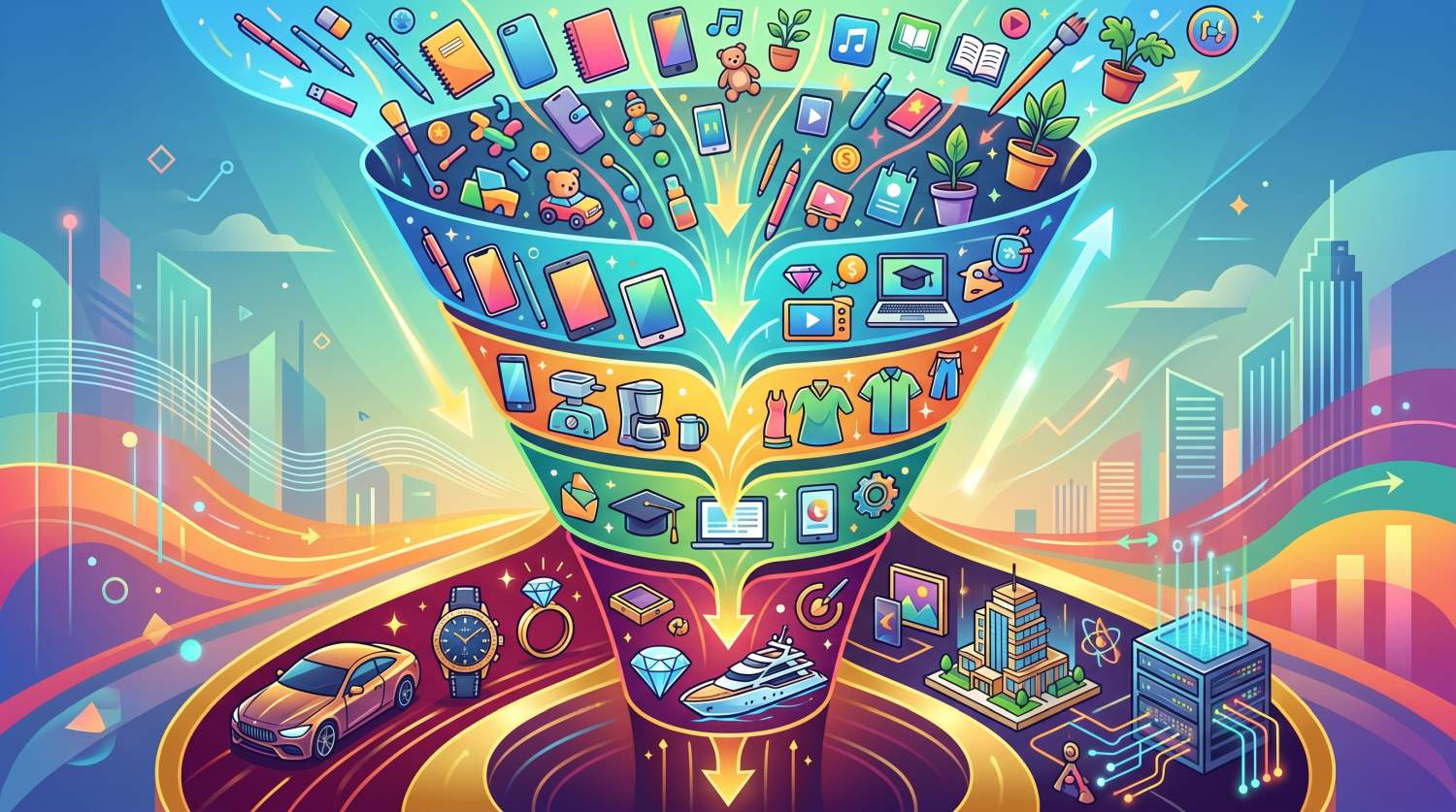
Instead of offering disconnected products, you build a structured sequence of offers that gradually increase in price and value. Each step naturally leads to the next.
At the very top of the funnel, you have free content. This could be videos, articles, podcasts, or any form of valuable information that attracts attention and builds trust.
The next step is a free opt-in, such as a lead magnet. This might be a guide, checklist, or short resource that requires an email address. At this point, the person officially enters your ecosystem.
From there, you introduce a low-cost product. This is your entry-level offer. It should be inexpensive but extremely valuable. The goal is not to maximize profit at this stage, but to create a strong positive impression.
If done correctly, this product will make the customer think, “If this is what I get for a small amount of money, what else is available?”
That question drives them deeper into the funnel.
Building the Value Ladder
After the entry-level product, each subsequent offer increases in both price and depth.
You might move from a low-cost product to mid-tier products such as more advanced guides or specialized training. Then to higher-priced courses or programs that deliver more comprehensive solutions.
Beyond that, you can introduce premium services like group coaching, consulting, or done-for-you solutions. At the very bottom of the funnel are your highest-ticket offers—personalized, exclusive, and significantly more expensive.
At each level, fewer people will buy.
That is expected.
But the revenue per sale increases dramatically, which means your total income grows even as the number of buyers decreases.
How Each Product Sells the Next One
A key principle of the product funnel is that every offer is designed to lead into the next.
Your entry-level product should not try to do everything. Instead, it should solve a meaningful problem while naturally introducing the next level of value.
Each step builds trust, demonstrates results, and increases the customer’s willingness to invest more.
By the time someone reaches your higher-end offers, they are no longer a cold buyer. They already know who you are, they trust your expertise, and they have experienced the value you provide.
This makes higher-ticket sales far easier than trying to sell expensive services to strangers.
The Real Metric: Lifetime Customer Value
When you implement a product funnel correctly, your perspective on revenue changes.
Instead of focusing on the price of your cheapest product, you start thinking in terms of lifetime customer value.
A person who enters your ecosystem through a low-cost offer is not worth just that initial amount. Over time, as they move through your funnel, they may purchase multiple products and services.
That single customer could be worth hundreds or even thousands of dollars.
This is where real scalability comes from.
The power of the product funnel comes from alignment with human behavior.
People rarely make large financial commitments immediately. They need time to build trust, understand value, and see results.
By offering a progression of products, you meet customers where they are and guide them forward step by step.
At the same time, you are maximizing the value of each relationship instead of constantly chasing new leads.
If you are building your first business, you do not need a complex funnel right away.
Start simple.
Create valuable free content to attract attention. Develop one strong entry-level product that delivers real results. Then design one or two higher-level offers that expand on that foundation.
Even a basic funnel with three or four levels can significantly increase your revenue compared to selling a single product.
As your business grows, you can expand and refine the funnel over time.
Most people underestimate how much money they can make from a single customer because they are thinking too narrowly.
They focus on one transaction instead of a long-term relationship.
The product funnel changes that completely. It allows you to build a system where each customer has the potential to generate far more value over time.
If you implement this properly, you will not just make more money. You will build a more stable, scalable, and predictable business.
And once you see it working, you will wonder why you ever tried to run your business any other way.
AI did NOT write this article. The article comes 100% from me and is 100% my content. However, AI was used to transcribe this content from some of my other social media which is why the voice is a little different. It’s still 100% my content and not written by AI. AI will never “write” my content! Remember that you can always go to calebjonesblog.com and subscribe to my Substack if you want articles physically written by me with no AI involvement whatsoever.
Leave your comment below, but be sure to follow the Five Simple Rules.
Sorry, the comment form is closed at this time.